English
 Deutsch
An intense, adventurous, and finely curated itinerary in true TransAfrica style leads us into the very soul of the African continent. We’ll uncover remote villages, sculpted clay bas-reliefs, and majestic waterfalls cascading through the rugged savannah of the Fouta Djalon, the largest mountain massif in West Africa.
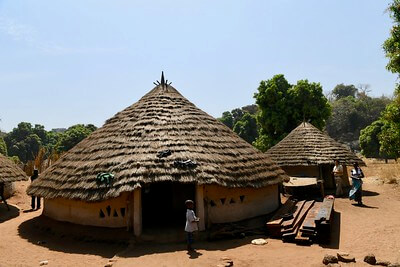
In a grand clay structure crowned by a decorated conical thatched roof, we’ll be welcomed by the Council of Elders, proud descendants of one of the oldest Fulla kingdoms. Further south, in the land of the Malinke, heirs of the once-mighty Mali Empire will introduce us to the ancient knowledge of healing and magical forest plants.
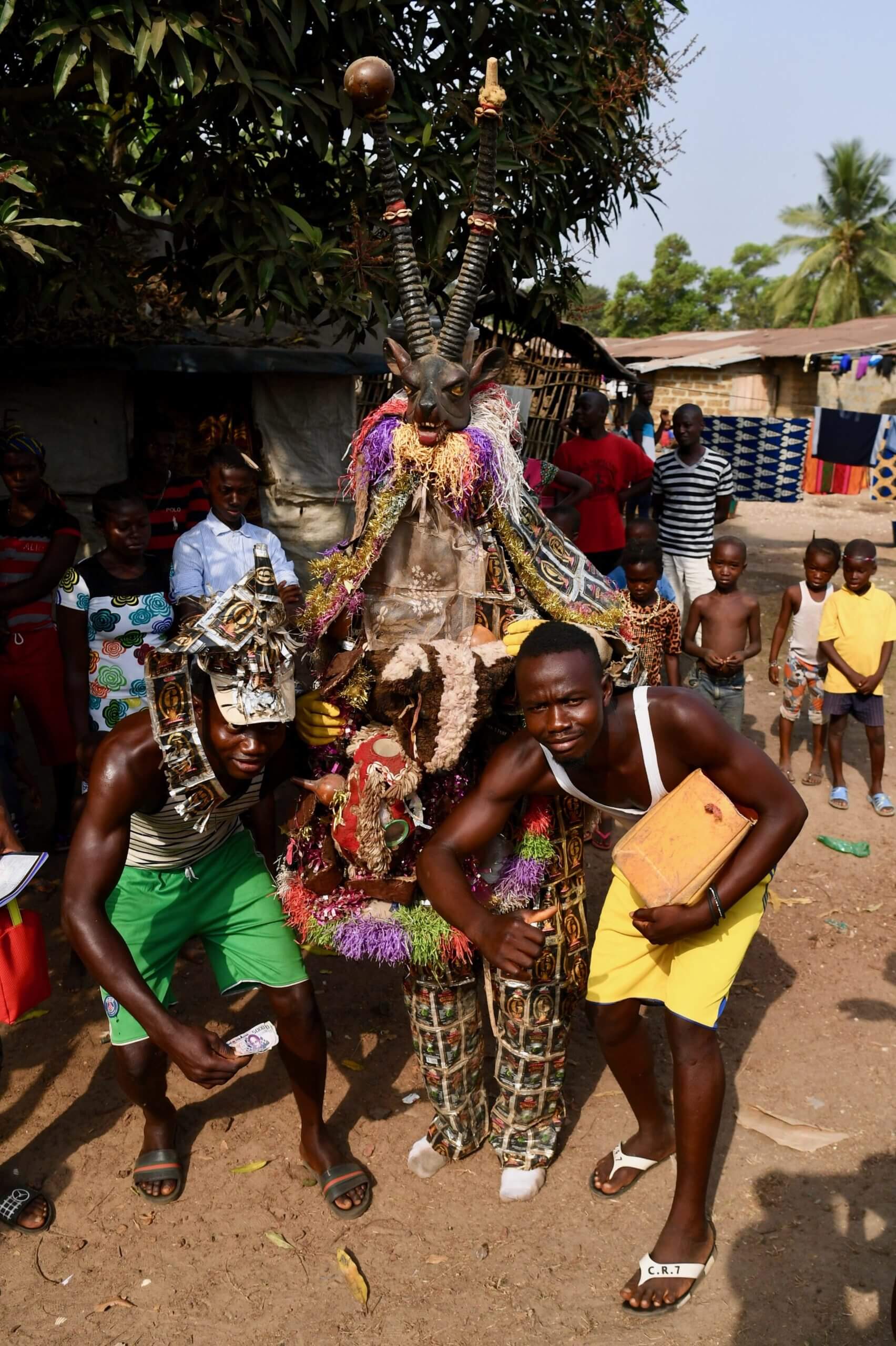
We’ll drive forgotten tracks to witness sacred mask dances, where the rhythmic echo of tam-tams resonates through mystical woodlands. We’ll observe powerful rites like the initiation dances of young girls, cross the longest liana bridges suspended above jungle rivers, and visit secret villages where the legendary bird-men still guard ancestral traditions.
Our journey is also a celebration of taste, with authentic African gastronomy and local delicacies shared in welcoming villages.
In Liberia, we arrive in Monrovia, the “Land of Freemen”. The only African country never colonized. Founded by freed slaves from the Americas, it gave birth to the rich and symbolic Krio culture. Between Liberia and Sierra Leone, we’ll explore its unique architecture carved in stone and wood, and uncover metaphysical symbols woven into daily life.
While sacred mask dances across West Africa are traditionally a male domain, here we will witness the rare and powerful Bundo mask ceremony. An all-female initiation ritual, equally spiritual and secret.
Our odyssey ends with an ocean adventure : a night spent on the untouched Banana Islands, where lush forest meets the deep blue sea, remote coves, and quiet fishing villages.
We’ll explore the Freetown Peninsula, home to some of the most stunning beaches in West Africa, nestled between green mountains and the Atlantic Ocean. From here, we visit the Tacugama Chimpanzee Sanctuary and the vibrant, history-rich capital of Freetown, completing an unforgettable journey through lands where history, culture, and nature meet in raw beauty.
Price 2026:
US$7,558.- in group of 6 or more guests
US$8,858.- in group of 4 to 5 persons
US$8,858.- in group of 2-3 persons – when booked 90 days or more prior departure
Single supplement:US$1,014.-
Tour start dates in 2026: Jan 24, Feb 21, March 21, Dec 26, 2026
Dec 26 departure add US$ 150 Festive Season charge.
Price per person, sharing occupancy.
Price includes: comfortable minibus adapted to African roads, always with air-conditioning. Sailing at Banana Island will be with local boats and will depend on weather condition. Local ferry from Freetown to Lungi (45 minutes) Accommodation in cities are international standard hotels, At Banana Island fixed tented camp facing the ocean; in the countryside best available. Most rooms have airconditioning. Lunches are either picnic or at restaurants, dinners at hotels from tourist menu. Airport transfers. Tours and activities as per the package, All meals as listed as B=breakfast, L=Lunch (cold meals-picnic), D=Dinner (pre-selected menus); Entrance fees to parks, concessions, protected areas and cultural sites.
Price excludes: International flight to Conakry and from Freetown Int. Airport, Visas mandatory prior arrival. Drinks or mineral water during meals and at hotels, baggage assistance, feed for photos and videos being taken, mandatory travel and evacuation insurance, Cost related to delayed baggage arrival due to airline issues.
Maximum participants 16 persons.
Note: Due to the nature of this journey, the itinerary, visits, and overnights might be modified based on the unquestionable decision of the tour leader who will do his upmost best to stick to the program. The itinerary is made to discover places where foreigners are not yet common. Understanding and flexibility are necessary for a trip “outside the known tracks”. Thanks to the right attitude we will profit from a unique experience and appreciate the beauty of the landscapes, the hospitality of the locals, and the ceremonies which will be shared with us by the local people.
DAY 1: CONAKRY
Arrival and transfer to hotel.
DAY 2: THE CAPITAL (140 Km, driving time 4 hr)
Brief visit to the capital and to the interesting small museum if open. After leaving the traffic jam, we will head to the mountains of Kindia. Kindia is a pleasant trading town between Fouta Djallon, the coastal regions, and the western forests.
Dinner will be a unique degustation of different specialities of Guinean gastronomy.
Illuminated by the glare of the fire, called by the intense rhythm of the drums will appear and dance the local mask from the sacred forest, the main and more spectacular is the Baga Nimba, considered one of the symbols of the country.
DAY 3: DALABA (280 km, driving time 8 hr)
Today, the road leads us deep into the Fouta Djalon massif, a land of high plateaus, waterfalls, and cool mountain air. We arrive in Dalaba, a peaceful town perched at 1,200 meters (3,900 ft), where time seems to slow and the views stretch endlessly.
In the late afternoon, we explore Dalaba’s quiet charm. Of particular interest is the Casa a Palabra, the “House of Words”. Adorned with elegant bas-reliefs in the traditional Fulla (also known as Fulani or Peul) style. This was once a place where local chiefs met with colonial officials, a space of dialogue and negotiation.
Nearby stands the former governor’s villa, later repurposed by Ahmed Sékou Touré, Guinea’s first president and a fierce anti-colonial leader. Rejecting all ties with France, Touré aligned the country with the Soviet Union and socialist states, becoming a close ally of Ceausescu. Over time, Guinea grew increasingly isolated, and Touré’s regime hardened into a dictatorship. The villas once used by his ministers and foreign guests remain as echoes of this complex era.
In one such villa, a remarkable moment in history took place… Singer Miriam Makeba met and married Stokely Carmichael, a prominent Black Panther exiled from the United States.
We settle in at the comfortable Tinka Hotel, our base for two nights amid the fresh mountain breezes of Fouta Djalon.
DAY 4: FOUTA DJALON AND THE COUNCIL OF THE ELDERS (100 km, short drives)
A full day to discover the hearth of the largest mountain massif of West Africa: Fouta Djalon, where the mountains meet the savannah and in the deep valleys the forests. Here the highest waterfalls make the landscape more beautiful and site the “water basin” of West Africa. Thanks to a fresh climate, this region has been the most appreciated holiday site during colonial time. Fulla people origins come from this region; Peul are known for their stunning beauty and for being the best zebu breeders od West Africa.
A 1.30h walk in the forest to discover the Ditin waterfall which are the highest of the region (100m.). After having been introduced by our connections to the elders, presenting traditional gifts as cola nuts, we will have the honour to be received by chiefs and dignitaries sitting in council. In a very large clay round hut with a decorated grass roof, dressed in traditional costumes the descendant of one of the oldest Fulla Kingdom will tell us the history of their people and accept to answer our questions about the origins of their tribe and the traditional roles stilll practiced.
Return to our comfortable hotel.
DAY 5: AFRICAN ORAL TRADITIONS (250 Km rough roads)
We depart early for a full day’s drive, descending from misty mountains into the rolling hills and open bush savanna of the High Guinea region. This land is home to the Malinke people, proud descendants of the mighty Mali Empire.
Before reaching Faranah, the regional capital and birthplace of Guinea’s first president, Ahmed Sékou Touré. We’ll cross an old iron bridge spanning the legendary Niger River. Originating here in the highlands, the Niger gathers strength from countless tributaries, becoming West Africa’s largest and longest river. From Guinea, it winds through Mali, Niger, Benin, and finally Nigeria, where it empties into a vast estuary over 3,000 miles downstream.
Our hotel awaits just outside town, nestled in the savannah’s golden embrace.
After dinner, we’ll immerse ourselves in an unforgettable cultural evening. In a nearby village, gathered around a crackling fire, we’ll experience traditional music performed by a Griot, the revered “African Troubadour.” This hereditary caste passes down centuries of stories, history, and emotion through song and instruments. Their performances weave tales of love, history, and pure joy, preserving the oral traditions of the region.
As Senghor, Senegal’s first president and Nobel laureate, wisely said : “In Africa, every Griot who dies is a library that burns.”
DAY 6: ANCIENT HERBAL MEDICINE (160 km, driving time 4 hr)
Today promises an easy yet unforgettable journey. In the morning, we’ll visit a traditional Malinke village, where round grass huts dot the landscape and warm smiles welcome us. The village chief, a respected guardian of age-old customs, will greet us with open arms, sharing stories of their vibrant culture.
Next, we venture into the tropical forest, guided by the local Dozo, legendary warriors, hunters, and healers. Steeped in ancient traditions, the Dozo undergo rigorous initiation, mastering African herbalism and the mystical powers of forest plants. With a bit of luck, they may reveal some of their secrets to us. Clad in traditional costumes adorned with protective magic amulets, these fearless warriors still serve as vital allies to local authorities, safeguarding their communities from harm.
We’ll enjoy a picnic surrounded by the wild beauty of the forest before heading to Kissidougou in the afternoon. This bustling trading hub sits at a crossroads between savanna and forest tribes, where a large market pulses with the exchange of goods from diverse origins.
After a day rich with culture and nature, unwind at our comfortable, air-conditioned hotel, complete with an open-air restaurant overlooking the swimming pool.
DAY 7: FROM STONE GODS TO THE TOMA ETHNIC GROUP (170 km, driving time 5 hr).
Before leaving town, we’ll explore a small but fascinating museum showcasing ritual artifacts from the region. The Kissi ethnic group is renowned for worshiping mysterious stone gods called Pomo, ancient sculptures discovered deep in the surrounding forests. Silent witnesses to a rich spiritual heritage.
Our journey then leads us through a striking transition from open, tree-lined savannahs to the lush, dense embrace of tropical forest. We’ll stop for lunch in Guekedou, a bustling border town where Guinea, Sierra Leone, and Liberia meet. Every day, thousands flock here to trade at its vibrant market, a lively crossroads of cultures and commerce.
Guekedou is also known as the unintended epicenter of the devastating 2014 Ebola outbreak that swept across the region, a sobering reminder of resilience amid hardship.
Later, arriving in Macenta, we’ll witness a captivating cultural moment : the Toma young girls’ initiation dances. This powerful ceremony marks the end of puberty rites, celebrating their transition into adulthood and readiness for marriage. A vibrant blend of tradition, rhythm, and community spirit.
DAY 8: BIRD MEN AND LIANAS BRIDGES (160 km, driving time 4 hr, various drives)
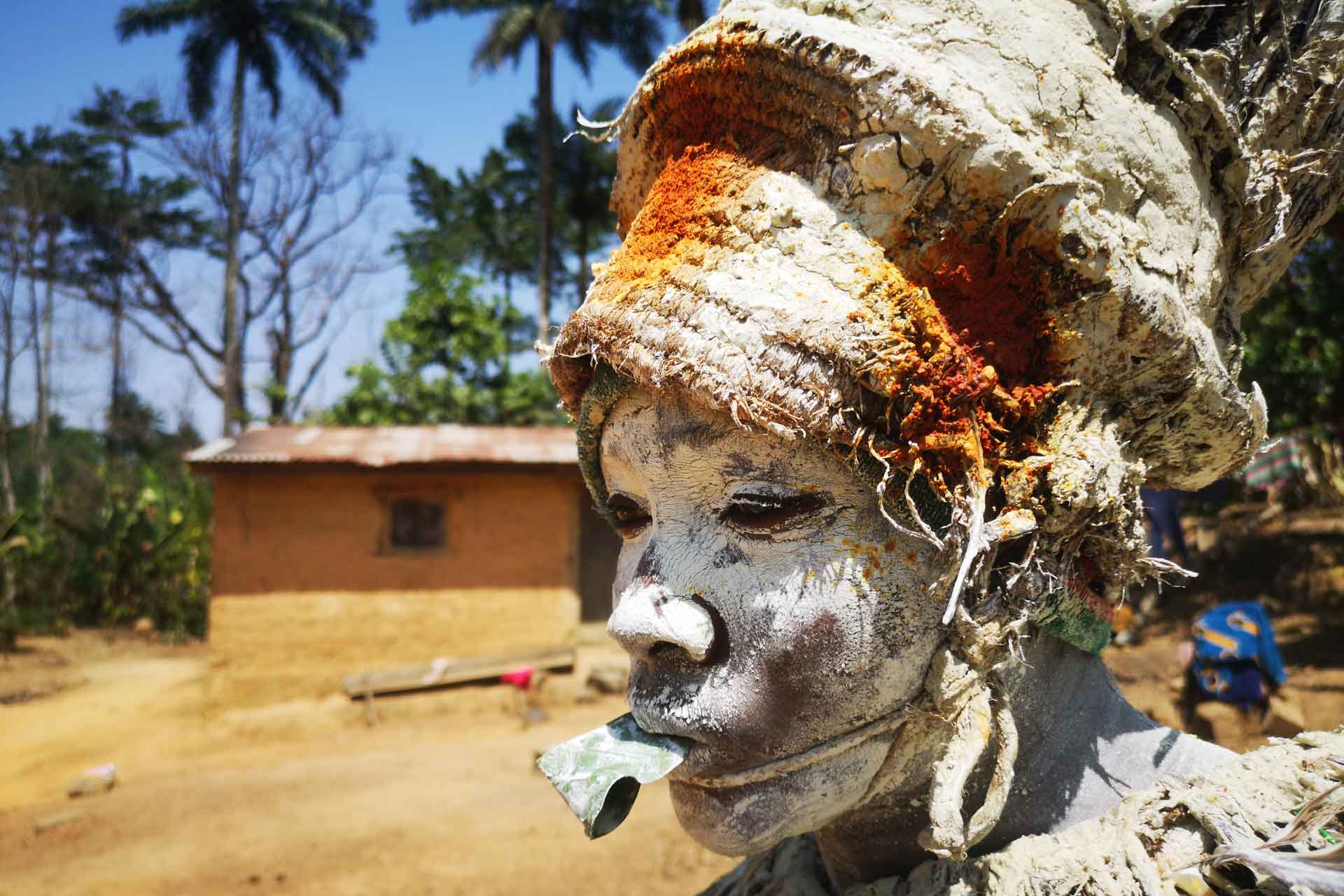
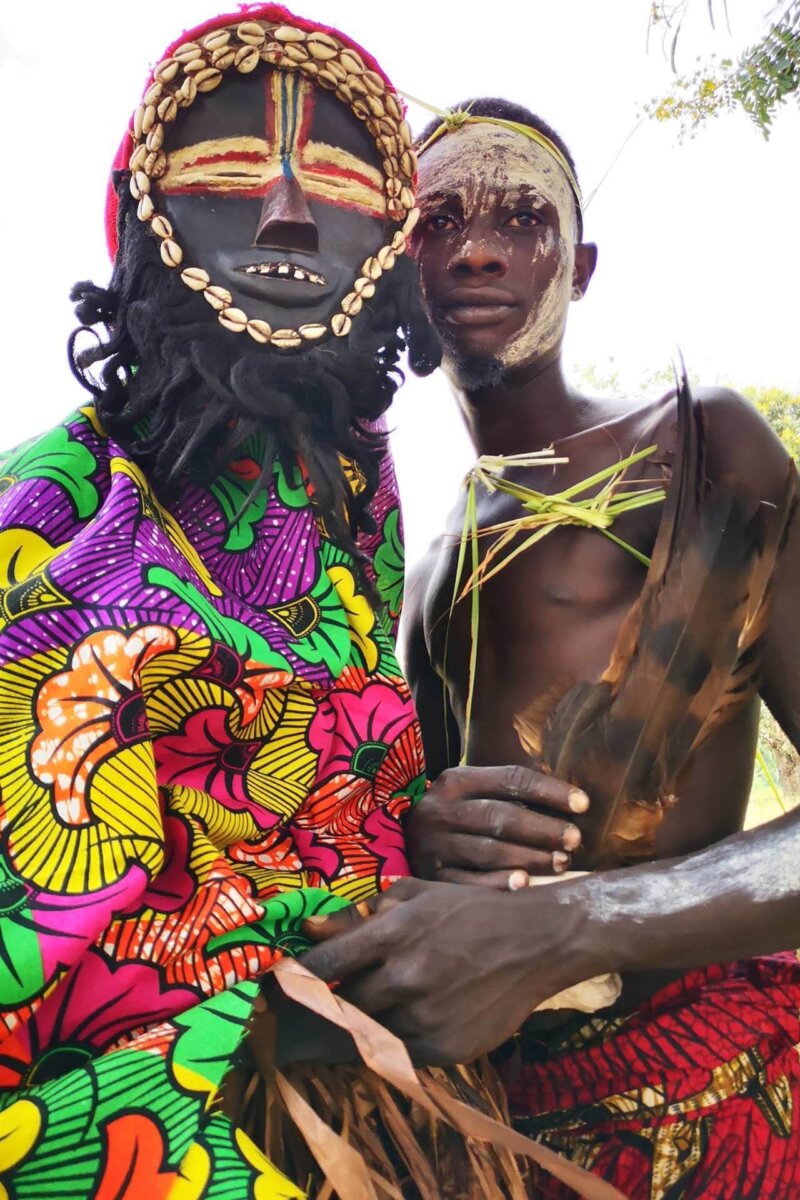
In the remote forests, the Toma people, locally known as Loma, guard a powerful tradition of sacred masks living deep within the jungle. We will witness one of West Africa’s most spectacular and little-known sacred dances : the Birdmen ceremony. These enigmatic figures, their faces painted white with kaolin and draped entirely in feathers, belong to a secret initiation passed quietly from father to son for centuries. They are believed to possess magical powers, including the ability to become invisible. During tribal wars, Birdmen were the fastest messengers, able to slip through enemy lines unseen.
As the rhythmic beats of tam-tam drums echo through the village, the entire community gathers to celebrate this ancient rite. During our scouting in the forest, we discovered a unique mask never before documented by anthropologists “a rare glimpse into a living, hidden culture”.
For lunch, savor a feast of local specialties, lovingly prepared by the village women, offering a true taste of regional gastronomy.
Beyond the ceremony, these remote mountains cloak other marvels. A narrow trail through thick, impenetrable vegetation leads us to a secluded village and a breathtaking liana bridgestretching across a wide jungle river. These bridges, masterpieces of “tribal technology,” can span up to 70 meters and are crafted solely from natural materials. Wood and lianas, without nails, rope, or anything foreign to the forest.
Only the initiated are permitted to harvest and prepare these materials, leaving them carefully hidden in the jungle. It is said a powerful forest spirit completes the bridge overnight. During bridge construction, women and uninitiated are forbidden from entering the forest to preserve the secret of this ancient craft.
Our journey ends in Nzerekore, the vibrant capital of the forest region, where the spirit of the jungle meets the energy of modern life.
DAY 9: NIMBA: MOUNTAINS AND FORESTS (60 Km, driving time 3 hr)
We set off early, winding along rugged roads and trails toward Liberia’s border in the heart of Nimba County. The Nimba Mountains, a spectacular massif straddling the borders of Guinea, Ivory Coast, and Liberia, tower up to 1,752 meters (5,748 ft). This breathtaking range is not only a UNESCO Biosphere Reserve but also a sanctuary of rare natural wonders.
As we ascend, the landscape transforms dramatically from dense tropical rainforest nestled in the valleys to an extraordinary tropical altitude forest above 1,000 meters. Our scenic drive cuts through this lush tapestry, leading us through the gates of the protected reserve to the Nimba Eco Lodge, perched at 900 meters where these two forest worlds meet.
From the Eco Lodge’s panoramic terrace, you can choose your adventure : embark on a one- or two-hour trek into the heart of an ancient primary forest, alive with hidden secrets, or simply unwind, letting the cool mountain breeze and sweeping vistas soothe your soul.
Local legend says that deep within these forests lives the Zogbenya, a mysterious spirit guardian of the Nimba peaks. Seen only by the pure of heart, the Zogbenya is said to protect the mountains and their wildlife, ensuring the balance between nature and humankind endures. Keep your eyes open… sometimes, the mountain breeze seems to whisper its presence.
DAY 10:LIBERIA, THE LAND OF FREEMEN (336 Km, driving time 8 hr)
We set off early for a long, thrilling day across Liberia. Our first stop lies in the rugged Nimba Mountains, where we’ll explore the ruins of vast iron mining operations abandoned since the civil war erupted in 1989. These ghostly remnants scarred mountain faces and silent, overgrown industrial sites feel like a frozen moment in time, a “day after” where nature quietly reclaims humanity’s fleeting mark.
As we journey onward, vibrant villages typical of English-speaking West Africa will paint the landscape with rich colors, alongside vast plantations of Hevea (rubber trees) thriving in this tropical paradise, where over 1,200 mm of rain nourish their bark each year. You’ll witness the delicate art of latex harvesting : precise incisions on the bark, with milky drops collected in small buckets. We’ll pause for a picnic lunch, savoring fresh tropical fruits and the wild surroundings.
Liberia stands apart in Africa’s history as the only nation never colonized or turned into a protectorate. Founded by freed slaves known as the Krio. Returning from the United States, it earned its name, “Liberia,” the land of the liberated. Though Krio make up only 5% of the population, they hold significant influence over the country’s economy and politics. Their language, Krio, a vibrant blend akin to American English pidgin, is spoken by nearly 80% of Liberians, uniting the nation.
As the sun sets, we arrive in Monrovia. Our base for two nights will be a comfortable ocean-view hotel perched on the West Point peninsula, offering sweeping views of the Atlantic and a gateway to Liberia’s captivating capital.
DAY 11: MONROVIA (A Day to explore or unwind)
Those who wish can relax by the hotel pool, while others set out on foot to uncover the soul of Monrovia.
Our first stop is the striking Masonic Temple, a powerful symbol of Krio culture and influence. Then, rising above the city, we find the ruins of the Ducor Palace Hotel, once the pride of West Africa and the first five-star hotel in sub-Saharan Africa. Legend says Idi Amin swam in its ocean-view pool, pistol on hip, while Miriam Makeba sang for him. Looted and abandoned during the war, a planned restoration by Kadhafi was halted by his fall from power.
We enjoy a traditional Liberian lunch, rich with African flavors, before visiting the National Museum, housed in a beautiful Krio-style building. Its exhibits include sacred masks, ritual artifacts, and a moving photo display from the two civil wars (1989–2003). The surrounding streets echo with Krio architecture, from colonial churches to grand wooden facades.
Back at the hotel, we relax and enjoy a fusion dinner with European and Lebanese touches.
DAY 12: DIAMONDS (310 km, driving time 7 hr)
Early departure. The Mano River marks the southern boundary between Liberia and Sierra Leone. After crossing the border, we will visit a traditional village, accompanied by our local friends who will proudly introduce us to their homes and way of life. A newly renovated road will lead us through a lush rainforest landscape and across wide rivers, as we enter a region renowned for its diamond wealth, an industry that has made the country internationally famous. Diamond prospecting is as addictive as gambling, with the promise of striking it rich becoming a reality for only a lucky few. Diamonds played a major role in the country’s civil war, and both the quantity and quality of stones still being unearthed remain significant today. Some villagers will guide us to an active mining site, where we’ll meet artisanal diamond seekers at work. One of them will explain the techniques of small-scale mining and the process of “sand washing.”
Arrival in Bo, the country’s second-largest city.
DAY 13: BUNDO FEMALE MASK (260 km, driving time 6 hr)
Bo is a lively and welcoming town, bursting with colour and character. Its bustling markets and “Diamond Shops” offer everything an intrepid seeker might need… Shovels, sieves, and all the essential tools to try your luck at unearthing glittering treasures from the earth.
In the morning, we venture into a nearby village to witness one of West Africa’s most extraordinary cultural expressions : the Bundo mask dance. While mask rituals are typically reserved for men in much of Africa, among the Mende people and their neighbours, the sacred Bundo masks belong to women. These powerful performances mark a young girl’s passage into womanhood and are deeply rooted in centuries-old initiation rites. The celebration is vibrant and full of energy, drawing an excited crowd from surrounding communities.
After this remarkable encounter, our journey continues towards the Atlantic coast. We head to the fishing village of Kent, where a traditional boat awaits. From here, we’ll set off across the sea to the mythical Banana Island. A secluded paradise of forest-covered hills, ocean breezesour and our home for the next two nights.
DAY 14: BANANA ISLAND
After days of thrilling overland travel through savannahs and deep forests, we reward ourselves with a well-earned escape : a full day on Banana Island, where adventure and tranquility meet the ocean breeze.
We board a wooden boat for a scenic circumnavigation of this legendary island, its emerald mountains blanketed in untouched primary forest. As we glide through the waves, tiny hidden coves and charming Krio fishing villages reveal themselves, remnants of an old Caribbean soul echoing through the landscape.
For the bold at heart, an optional two-hour hike through the shaded forest trails offers a deeper connection with the island’s wild nature. For those who prefer to unwind, our camp, nestled among the trees with views of the sea, invites you to slow down, listen to the rhythm of the waves, and sip something cool at the open-sky bar.
Whether you’re exploring jungle paths or lounging by the gentle waters of a secluded beach, this day is yours to enjoy the raw beauty and peaceful spirit of Banana Island.
DAY 15: FREETOWN PENINSULA: CHIMPS (30 minutes by boat + 70 km by road, various short drives – approx. 2 hrs driving time).
After bidding farewell to Banana Island, we return to the mainland and continue our journey along the wild and scenic slopes of the Freetown Peninsula. This dramatic mountain range known as the “Sierra of Lions,” from which Sierra Leone takes its name, forms one of the most breathtaking coastlines in West Africa.
Our route winds between emerald hills and stretches of golden beach, leading us inland to a rare sanctuary : the Tacugama Chimpanzee Reserve. Tucked deep within the rainforest, this remarkable project is home to more than 120 rescued chimps, each with its own story of survival. As we explore the sanctuary, we gain insight into the ongoing efforts to protect these intelligent primates and their fragile habitat.
With memories of forest calls and ocean air in our hearts, we end the day with a scenic drive into Freetown, where the vibrant pulse of the capital awaits.
DAY 16: FREETOWN: A LONG HISTORY
Freetown is not just a capital, it is a city built on stories of liberation, survival, and rebirth. Today, we delve into its remarkable history and vibrant spirit. In 1786, 308 freed slaves from the United States, many of whom had fought alongside the British during the American Revolutionary War, were resettled here, only to face disease, conflict, and harsh conditions. Their dream of a new beginning nearly vanished. But in 1792, the settlement was reborn as Freetown, under British protection, becoming a beacon of hope for thousands more freed slaves. It later survived a French naval attack and went on to become the first British colony in tropical Africa. We’ll explore the city on foot, uncovering symbols of its storied past. At the heart of Freetown stands the legendary Cotton Tree, once a gathering place for former slaves. It stood tall for over two centuries before a storm felled it in 2023, leaving behind a powerful monument to resilience. Nearby, the imposing Supreme Court, Saint George’s Cathedral, and the National Museum reflect the city’s rich Krio heritage and its place in African intellectual history, home to Fourah Bay College, the oldest university in sub-Saharan Africa, and a city once known as the “Athens of West Africa.”Despite its turbulent past including civil war and the Ebola crisis. Freetown today is alive with music, colour, and the unstoppable energy of its people. As the sun begins to dip, we board a vibrant local ferry that carries us across the wide bay toward Lungi, where the journey ends.
Transfer to the airport for departure